

The ARRMA Grom battery charger situation confuses a lot of new owners because the truck ships without a battery or charger included. You’re staring at an empty battery tray wondering what actually fits, what voltage you need, and whether that random charger from your old drone will work. This guide answers every compatibility question in plain terms so you can start bashing today.
We’ve been running Groms since they launched, and the battery situation is actually simpler than it looks once you understand three things: voltage, connector type, and physical dimensions. Get those right, and you’ve got dozens of compatible options. Get them wrong, and you’re either returning batteries or worse — damaging your electronics.
By the end of this article, you’ll know exactly which batteries fit the Grom’s compact tray, which chargers handle 2S LiPo packs safely, and how to avoid the rookie mistakes that fry electronics or puff batteries. We’ll cover specific product recommendations, real-world runtime expectations, and the upgrade path when you’re ready for more punch.
Understanding the ARRMA Grom’s Power System
The Grom runs exclusively on 2S LiPo batteries — that’s two lithium polymer cells in series producing 7.4 volts nominal. This isn’t negotiable. You can’t run 3S packs even if they physically fit because the Grom’s ESC and motor are rated specifically for 2S voltage.
ARRMA designed the Grom around the 1/18 scale micro class, which means everything is proportionally smaller than their 6S trucks like the Kraton or Outkast. The stock brushless motor is a 380-size unit running at 8500Kv, paired with a 20A ESC. These components expect 7.4V input and will overheat or fail on higher voltage.
The connector type matters just as much as voltage. Groms ship with XT30 connectors — the smaller sibling of the XT60 you’ll find on full-size ARRMA trucks. XT30 connectors are rated for 30A continuous, which is plenty for the Grom’s power draw. You’ll need batteries with XT30 plugs or adapter pigtails to connect batteries with different plugs.
Here’s what trips people up: many 2S LiPo packs marketed for drones or other micro RCs use JST, EC2, or Deans connectors instead of XT30. These won’t plug directly into your Grom. You’ll either need to solder on new connectors or use adapter cables — though adapters add resistance and can wiggle loose during hard landings.
→ ARRMA Grom RC Car — the 1/18 scale brushless monster truck that’s become the go-to micro basher for backyard sessions and parking lot runs.
Battery Specifications That Actually Fit
Physical dimensions are the real limiting factor for Grom batteries. The battery tray measures approximately 72mm long, 35mm wide, and 23mm tall. Any pack larger than these dimensions simply won’t fit without modifications.
Capacity-wise, most owners run packs between 1300mAh and 1500mAh. You can technically fit smaller 850mAh packs, but runtime drops to around 8-10 minutes of hard driving. The sweet spot is 1500mAh — you’ll get 15-20 minutes of mixed bashing depending on how aggressive you drive.
Weight matters for handling. A 1500mAh 2S LiPo weighs roughly 85-95 grams depending on the brand. The Grom itself weighs about 480 grams ready-to-run without battery. Adding a heavy pack shifts the center of gravity and can make the truck more prone to rollovers during sharp turns.
Discharge rate (C-rating) determines how much current the battery can supply. For the Grom’s 20A ESC, you want at least a 25C discharge rate on a 1500mAh pack. That gives you 37.5A burst capability — more than enough headroom. Higher C-ratings like 50C or 75C won’t hurt anything, but you won’t see performance gains since the ESC is the bottleneck.
The balance lead is the small white connector with multiple wires coming off your LiPo. Every 2S pack has a 3-pin JST-XH balance connector regardless of the main discharge plug type. This balance lead is how your charger monitors and equalizes individual cell voltages during charging — critical for battery health and safety.
→ 2S LiPo Battery 1500mAh — compact 7.4V packs in the right dimensions for micro RC trucks, typically with XT30 or adaptable connectors.
Charger Types and Compatibility Explained
Any balance charger rated for 2S LiPo cells will charge Grom batteries safely. The key word is “balance” — you need a charger that connects to both the main discharge lead and the balance lead simultaneously.


Basic 2S balance chargers in the $15-25 range work fine for casual use. These plug into a wall outlet and charge at a fixed rate, usually around 800mA to 1A. Expect 90-120 minutes to fully charge a depleted 1500mAh pack. They’re foolproof but slow.
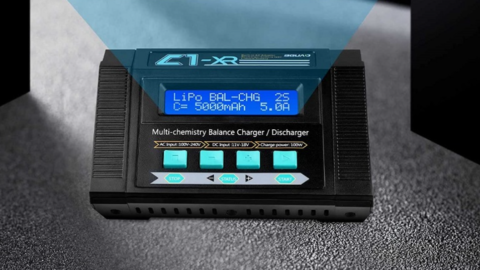
Programmable chargers like the B6AC or ISDT models offer more control. You can set exact charge rates, storage charge modes, and discharge functions. For a 1500mAh pack, charging at 1C (1.5A) is the safe standard — that’s a 60-minute charge from empty. You can push to 2C (3A) if you’re in a hurry, but consistent fast charging shortens battery lifespan.
The B6AC style chargers handle 1S through 6S LiPo, LiFe, NiMH, and NiCd chemistries. This versatility matters if you plan to expand into larger ARRMA trucks later. The same charger that handles your Grom’s 2S packs will charge 6S batteries for a Typhon or Kraton down the road.
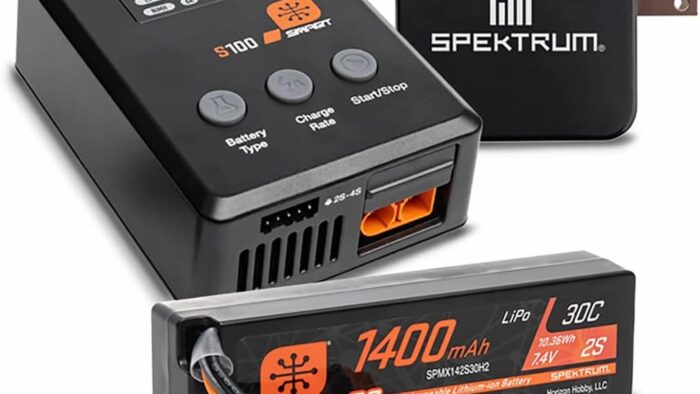
USB chargers designed for drone batteries are tempting because they’re cheap and compact. Most work fine for the Grom’s small packs, but verify they support balance charging. Some USB chargers only connect to the main lead and don’t balance cells — this leads to uneven cell voltages and premature battery failure.
Never use a NiMH-only charger on LiPo batteries. The charging profiles are completely different. LiPo requires constant current followed by constant voltage (CC/CV) charging with cell balancing. NiMH chargers use peak detection that will overcharge and potentially ignite a LiPo pack.
→ LiPo Balance Charger B6AC — handles 1S-6S packs with programmable charge rates, perfect for growing your ARRMA collection beyond the Grom.
XT30 Connectors: The Compatibility Bottleneck
XT30 connectors are smaller and less common than the XT60 standard used on full-size RC cars. This creates a compatibility gap because many hobby-grade 2S batteries ship with XT60, Deans, or EC3 plugs instead.


You have three options when your battery doesn’t have XT30. First, buy batteries specifically marketed for micro RCs or FPV quads — these commonly include XT30. Second, solder XT30 connectors onto your existing batteries. Third, use adapter pigtails that convert between connector types.
Soldering is the cleanest solution long-term. XT30 connectors cost about $0.50 each, and the solder joints handle current better than adapter cables. If you’re new to soldering, practice on scrap wire first. The key is tinning both the wire and connector terminal before joining them.
Adapter pigtails work but add resistance and potential failure points. A typical XT30-to-XT60 adapter adds 5-10 milliohms of resistance, which translates to slightly reduced power delivery and heat generation at the connection. More concerning, the extra connection can wiggle loose during crashes or hard landings.
If you go the adapter route, secure the connection with electrical tape or heat shrink. Some owners zip-tie the adapter junction to the chassis to prevent movement. Just don’t over-tighten and stress the solder joints inside the connectors.
The balance lead connector is standardized across almost all LiPo batteries. Your 2S pack will have a 3-pin JST-XH balance plug that fits any hobby charger’s 2S balance port. You don’t need adapters for the balance side — only the main discharge connector.
→ XT30 Connector Pigtail — adapter cables that let you use batteries with different plug types on your Grom without soldering.
Safe Charging Practices for LiPo Batteries
LiPo batteries require more careful handling than the NiMH packs you might remember from older RC cars. They store significant energy density, and mishandling can cause fires. This isn’t fear-mongering — it’s basic safety that every RC hobbyist should understand.
Always charge on a non-flammable surface away from combustible materials. Concrete garage floors, metal trays, or ceramic tiles work well. Never charge on carpet, wood furniture, or near curtains. A charging fire can spread in seconds.
LiPo safe bags provide an extra layer of protection during charging. These fire-resistant pouches contain flames and sparks if a battery fails. They’re not fireproof — a serious thermal runaway will burn through eventually — but they buy time to react and contain minor failures completely.
Never charge a puffed or damaged battery. If your LiPo looks swollen, has dents in the foil, or shows any physical damage, it’s done. Dispose of it properly at a battery recycling center after discharging it completely. Charging a damaged pack is asking for a fire.
Don’t leave charging batteries unattended. This is the hardest rule to follow because charge times can exceed an hour. At minimum, stay in the same room and check periodically. If you smell anything unusual or see the pack swelling, disconnect immediately and move it outside.
Storage voltage matters for battery longevity. If you won’t use your Grom for more than a week, store batteries at 3.8V per cell (7.6V total for 2S). Most programmable chargers have a storage mode that automatically brings packs to this level. Storing fully charged or fully depleted shortens lifespan significantly.
Temperature affects charging safety. Never charge a battery that’s hot from use — let it cool to room temperature first. Similarly, don’t charge in freezing conditions. The ideal charging temperature range is 50-85°F (10-30°C).
→ LiPo Safe Bag Storage — fire-resistant charging and storage pouches that contain failures and protect your workspace.
Real-World Runtime and Performance Expectations
A 1500mAh 2S pack delivers 15-20 minutes of runtime in the Grom under typical bashing conditions. That’s mixed throttle — some full-send moments, some cruising, occasional stops. If you’re pinned at full throttle constantly, expect closer to 12 minutes.
The Grom’s stock gearing and 8500Kv motor pull roughly 8-12 amps under normal load, spiking to 15-18 amps during hard acceleration or climbing. This current draw determines how fast your battery depletes. Higher C-rating batteries maintain voltage better under load, which translates to more consistent power throughout the run.
Terrain affects runtime dramatically. Smooth pavement is the most efficient surface — the Grom rolls freely with minimal motor effort. Grass increases resistance significantly, especially if it’s thick or wet. Expect 30-40% reduced runtime on grass compared to pavement.
Temperature impacts both battery capacity and motor efficiency. Cold batteries deliver less capacity — a 1500mAh pack at 40°F might only provide 1200mAh of usable energy. Hot conditions reduce motor efficiency and increase current draw. The sweet spot is 65-75°F ambient temperature.
If you’re comparing to the Mojave Grom or Typhon Grom variants, runtime is essentially identical since they share the same power system. Body style and weight differences are negligible at this scale.
Most serious Grom owners keep 3-4 batteries in rotation. While one charges, you’re running another. With a fast charger and multiple packs, you can bash for hours without significant downtime. This is more practical than buying a single high-capacity pack that won’t fit the tray.
Common Mistakes and How to Avoid Them
Mistake one: buying batteries based on mAh alone without checking dimensions. A 2200mAh 2S pack sounds great until you realize it’s 85mm long and won’t fit the Grom’s 72mm tray. Always verify physical dimensions before purchasing.
Mistake two: using a charger without balance capability. Some cheap chargers only connect to the main discharge lead. Without balance charging, individual cells drift apart in voltage over time. One cell gets overcharged while the other gets undercharged — both conditions damage the battery and create safety risks.
Mistake three: running batteries to complete depletion. LiPo cells shouldn’t drop below 3.0V per cell (6.0V for 2S). The Grom’s ESC has low-voltage cutoff protection, but it’s set conservatively. If you notice power cutting out intermittently, that’s the LVC activating — stop driving immediately and recharge.
Mistake four: charging at rates higher than 1C without understanding the tradeoffs. Yes, your B6AC can pump 3A into a 1500mAh pack. That’s a 2C charge rate and will get you running faster. But consistent fast charging generates more heat and degrades cells faster. Save fast charging for when you genuinely need it.
Mistake five: ignoring connector condition. XT30 plugs wear out over hundreds of cycles. If you notice loose fit, arcing marks, or melted plastic around the connectors, replace them. A failing connector creates resistance, heat, and potential fire risk.
Mistake six: storing batteries in the car. It’s convenient to leave your Grom ready to go with the battery installed. But if that battery sits for weeks at full charge or gets exposed to temperature extremes in a garage, you’re shortening its lifespan. Remove batteries for storage and keep them at storage voltage in a climate-controlled space.
Upgrade Path: When You Want More Power
The Grom’s 2S system is fixed — you can’t upgrade to 3S without replacing the ESC and motor. That said, there’s room for optimization within the 2S framework.
Higher-quality batteries with better discharge rates deliver more consistent power. A premium 75C pack maintains voltage better under load than a budget 25C pack, even though both are technically compatible. You’ll notice slightly better acceleration and more punch at the end of runs.
Upgrading to a quality charger pays dividends in battery longevity. Cheap chargers often have poor voltage regulation and imprecise cell balancing. A good charger keeps your packs healthier longer, which saves money over time even though the upfront cost is higher.
If you want significantly more power, the honest answer is moving to a larger platform. The Granite Voltage offers a step up in size while remaining relatively affordable. Or jump straight to 6S trucks if budget allows — the power difference is transformative.
Some owners experiment with higher Kv motors in the Grom, but this creates heat issues with the stock ESC. The 20A ESC is already working near its limit with the stock motor. A hotter motor pulls more current and risks burning out the speed controller.
The practical upgrade path for Grom owners who want more is buying a second, larger truck rather than trying to modify the Grom beyond its design limits. Keep the Grom for indoor running, tight spaces, and situations where you can’t risk a full-size truck. Add a 3S or 6S truck for open bashing.
Side-by-Side Battery Comparison
| Specification | Budget 2S 1300mAh | Quality 2S 1500mAh |
|---|---|---|
| Nominal Voltage | 7.4V | 7.4V |
| Capacity | 1300mAh | 1500mAh |
| Discharge Rate | 25C | 50-75C |
| Max Burst Current | 32.5A | 75-112A |
| Typical Dimensions | 68mm x 34mm x 20mm | 70mm x 35mm x 22mm |
| Weight | 70-75g | 85-95g |
| Expected Runtime | 12-15 minutes | 15-20 minutes |
| Connector Type | Varies (often JST) | XT30 or XT60 |
| Price Range (2026) | $12-18 | $22-35 |
| Cycle Lifespan | 150-200 cycles | 300-400 cycles |
Charger Feature Comparison
| Feature | Basic 2S Charger | B6AC Style Charger |
|---|---|---|
| Supported Cells | 2S only | 1S-6S |
| Charge Rate | Fixed 0.8-1A | Adjustable 0.1-6A |
| Balance Charging | Yes | Yes |
| Storage Mode | No | Yes |
| Discharge Function | No | Yes |
| Chemistry Support | LiPo only | LiPo, LiFe, NiMH, NiCd |
| Display | LED indicators | LCD screen |
| Power Source | Wall outlet | AC or DC input |
| Price Range (2026) | $15-25 | $35-65 |
| Future Compatibility | Limited | Grows with hobby |
Frequently Asked Questions
Can I use 3S batteries in the ARRMA Grom?
No, the Grom’s ESC and motor are rated exclusively for 2S (7.4V) power. Running 3S (11.1V) will immediately damage the electronics. The ESC has no voltage protection for overvoltage conditions, so you’ll fry components within seconds of plugging in a 3S pack.
What connector does the ARRMA Grom use?
The Grom uses XT30 connectors for the main battery connection. This is smaller than the XT60 standard found on full-size ARRMA trucks. You’ll need batteries with XT30 plugs or adapter pigtails to connect batteries with different connector types.
How long does a Grom battery last per charge?
A 1500mAh 2S LiPo provides 15-20 minutes of runtime under typical bashing conditions. Aggressive full-throttle driving reduces this to 12-15 minutes. Smooth pavement maximizes runtime while grass and rough terrain drain batteries faster due to increased motor load.
Can I charge Grom batteries with a USB charger?
Some USB chargers work for Grom batteries if they support 2S LiPo balance charging. Verify the charger connects to both the main lead and balance lead. USB chargers that only connect to the main discharge plug won’t balance cells properly and can damage batteries over time.
What size battery fits the ARRMA Grom tray?
The Grom battery tray accepts packs measuring approximately 72mm x 35mm x 23mm or smaller. Most 1300-1500mAh 2S packs designed for micro RCs or FPV drones fit within these dimensions. Always verify physical measurements before purchasing.
Do I need a LiPo safe bag for charging?
A LiPo safe bag isn’t strictly required but is strongly recommended. These fire-resistant pouches contain flames and sparks if a battery fails during charging. Given the low cost and significant safety benefit, there’s no good reason to skip this precaution.
How do I know when my Grom battery needs replacing?
Replace batteries showing physical puffing or swelling, reduced runtime below 60% of original capacity, failure to hold charge, or any visible damage to the foil casing. A battery that takes significantly longer to charge or feels unusually warm during use is also due for replacement.
Final Verdict
The ARRMA Grom battery charger compatibility situation is straightforward once you understand the core requirements: 2S LiPo voltage, XT30 connectors, and physical dimensions under 72mm x 35mm x 23mm. Everything else is optimization.
For most owners, we recommend starting with two quality 1500mAh 2S packs with XT30 connectors and a programmable balance charger in the B6AC class. This setup costs roughly $80-100 total in 2026 and covers everything you need. The charger grows with your hobby if you later add larger trucks, and having two batteries means minimal downtime between runs.
Skip the ultra-cheap batteries and basic chargers. The money you save upfront gets spent on replacements when budget packs fail prematurely or cheap chargers damage cells through poor balancing. Quality components last longer and perform better — the math works out in your favor over time.
Always prioritize safety with LiPo batteries. Use a charging bag, never leave batteries unattended while charging, and store at proper voltage levels. These habits take minimal effort and prevent potentially serious consequences.
The Grom is an excellent entry point into ARRMA’s lineup, and proper battery and charger selection ensures you get the most out of it. Run your packs hard, charge them properly, and that little truck will deliver countless hours of backyard bashing before you’re ready to step up to something bigger.
Affiliate Disclosure: This post contains affiliate links, including Amazon links. If you purchase through these links, we may earn a small commission at no additional cost to you. As an Amazon Associate, Arrma Cars Reviews earns from qualifying purchases.